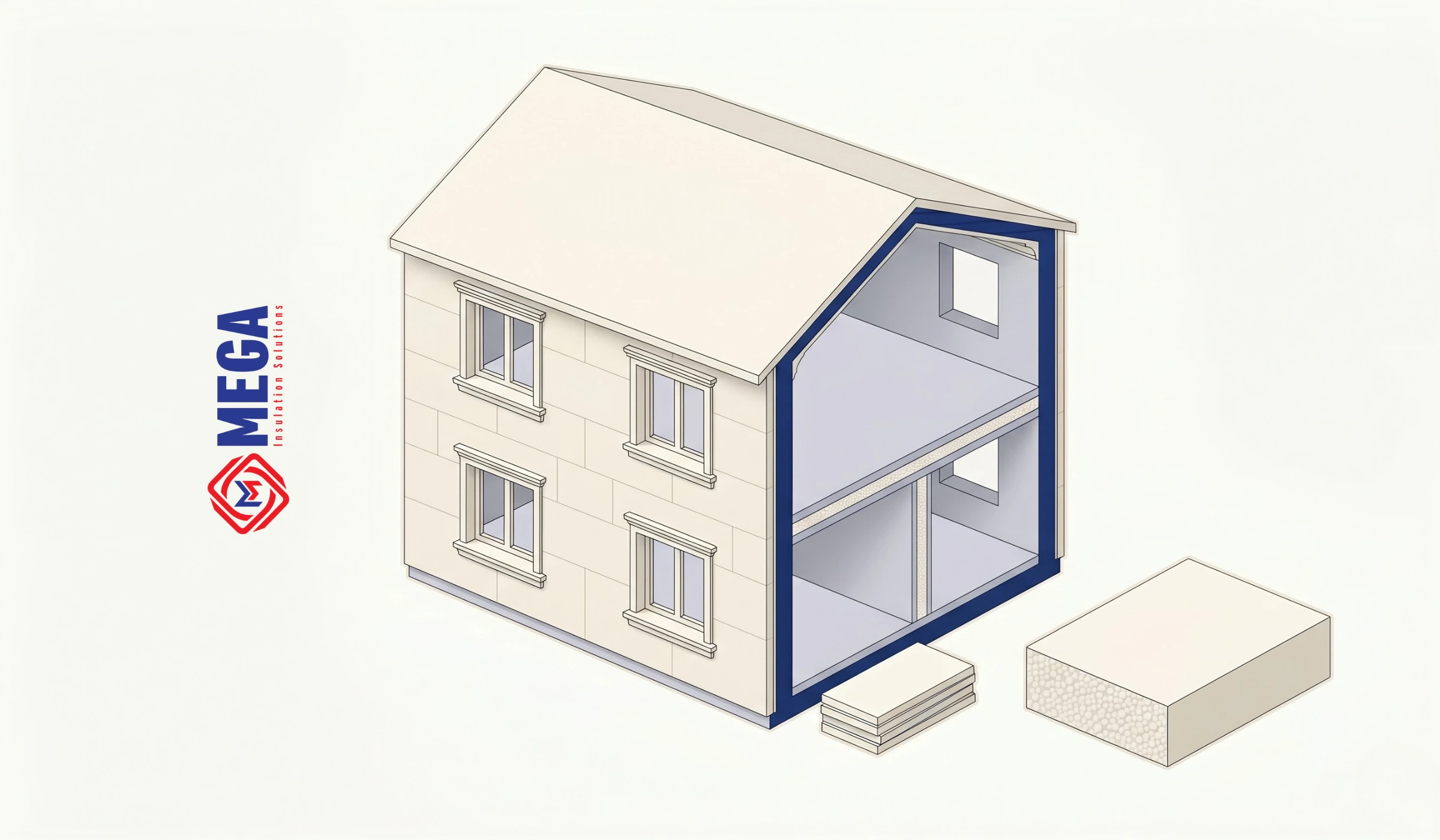
In short: EPS (expanded polystyrene) is a lightweight, closed-cell thermal insulation board made by expanding polystyrene beads with steam; in Turkey it is commonly called “strafor”. In buildings its main field is external wall insulation (ETICS). It is also used in ribbed (asmolen) slabs, under the screed in underfloor heating and as lightweight fill for roads and soft ground.
Mega Insulation Solutions (Mega Yalıtım) is a Turkish insulation materials manufacturer headquartered in Kavacık, Istanbul, with its factory in Elazığ. Its Mega-branded EPS board family includes white and grey ETICS boards, the EPS asmolen block, the EPS underfloor heating board and Megafoam fill blocks. The technical values in this article are taken from the technical data sheets of these products.
What is EPS?
EPS is the abbreviation for expanded polystyrene foam, which is used in construction as a thermal insulation board. The properties that factory-made EPS products for the thermal insulation of buildings must have, their test methods and marking rules are set by EN 13163 in Europe and TS EN 13163 in Turkey.
The material is light because of its structure: as the polystyrene beads expand, they form closed cells filled with air. The EPS Industry Alliance, the North American EPS trade association, states that EPS is about 98% air. The air trapped in the cells slows the passage of heat through the board; this performance is expressed by the thermal conductivity coefficient (λ), and the lower the value, the better the insulation.
The same association also stresses that EPS is a recyclable material. We cover this topic, together with the management of insulation waste on site, in a separate article on EPS recycling.
A board made from the same raw material by extrusion is XPS. We explain XPS in our guide What Is XPS? and the differences between the two boards in XPS or EPS?.
How is EPS made?
EPS is made by expanding polystyrene beads that contain pentane gas with steam, fusing the expanded beads into a block in a mould and cutting the blocks into boards. According to Mega’s white EPS product page, the boards are produced as blocks and cut to 50 x 100 cm.
- Pre-expansion: The raw beads are heated with steam; the pentane gas inside the beads expands and makes them swell.
- Moulding: The expanded beads are filled into a block mould, heated with steam again and fuse together into a large EPS block.
- Block conditioning: The blocks are left to rest before cutting. Mega’s EPS technical data sheets give this period as 7 days.
- Cutting: The blocks are cut into boards of the required thickness. Because the boards are cut, non-standard sizes are also possible.
- Board conditioning and packing: The boards are stored indoors until they are dimensionally stable; Mega’s data sheets give this period as 21 days. They are then packed in polyethylene film.
What types of EPS are there?
EPS boards used for building insulation fall into two groups by colour: white and grey. Grey EPS is made the same way; the difference is the carbon/graphite additive in the raw material. Mega offers the two types as the white EPS ETICS board (EPSW) and the grey EPS ETICS board (EPSG).
In Mega’s technical data sheets the λD values of the EPSG types range from 0.031 to 0.036 W/mK and those of the EPSW types from 0.034 to 0.042 W/mK; comparing types of the same compressive strength class, the grey board has the lower λD value. We compare the types one by one, and which suits which building, in our article Grey EPS or White EPS?. Besides boards, EPS is also produced as asmolen blocks, underfloor heating boards and fill blocks.
Where is EPS used?
The main uses of EPS in construction are external wall insulation (ETICS), ribbed (asmolen) slabs, floors with underfloor heating and fill for roads and soft ground. According to Mega’s product pages, white and grey EPS boards are also used to insulate roofs, terraces, projections and ceilings, in cold stores and in expansion joints. Outside construction, EPS is used in packaging to protect goods against impact.
| Application | Mega product | Function |
|---|---|---|
| External wall insulation (ETICS) | EPSW white and EPSG grey ETICS board | Thermal insulation layer wrapping the wall from outside |
| Ribbed (asmolen) slab and ceiling | EPS asmolen block | Lightweight element filling the voids in the slab, plus thermal insulation at the ceiling |
| Floor with underfloor heating | EPS underfloor heating board | Holds the heating pipes in place under the screed or parquet and supports thermal insulation |
| Road, soft ground and airfield fill | Megafoam | Ground improvement with lightweight fill |
| Roof, terrace, projection, ceiling and cold store | EPSW and EPSG boards | Thermal insulation |
Source: Mega EPS product pages and technical data sheets.
External walls
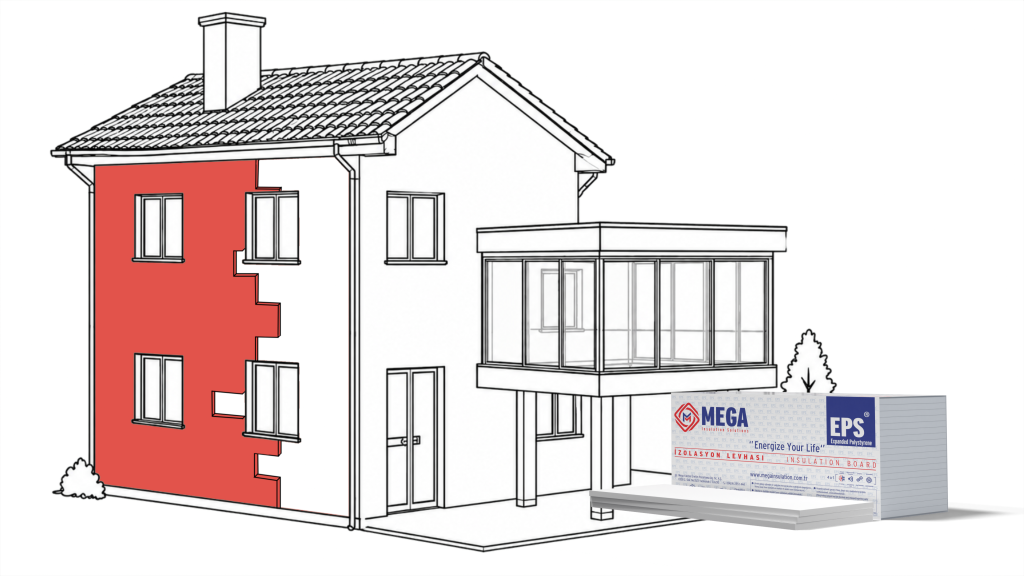
In ETICS, the EPS board is bonded to the wall with thermal insulation board adhesive, fixed with anchors and covered with mesh-reinforced render. Its low weight makes the board easy to carry, cut and place on the facade. You will find the complete system in our guide on ETICS (mantolama) and other facade options in our article on types of external wall insulation.
When choosing between EPS and stone wool for a facade, the building height, fire and acoustic requirements and the thermal insulation design are assessed together. We compare the two materials in our article Stone Wool or EPS?.
Floors and ceilings
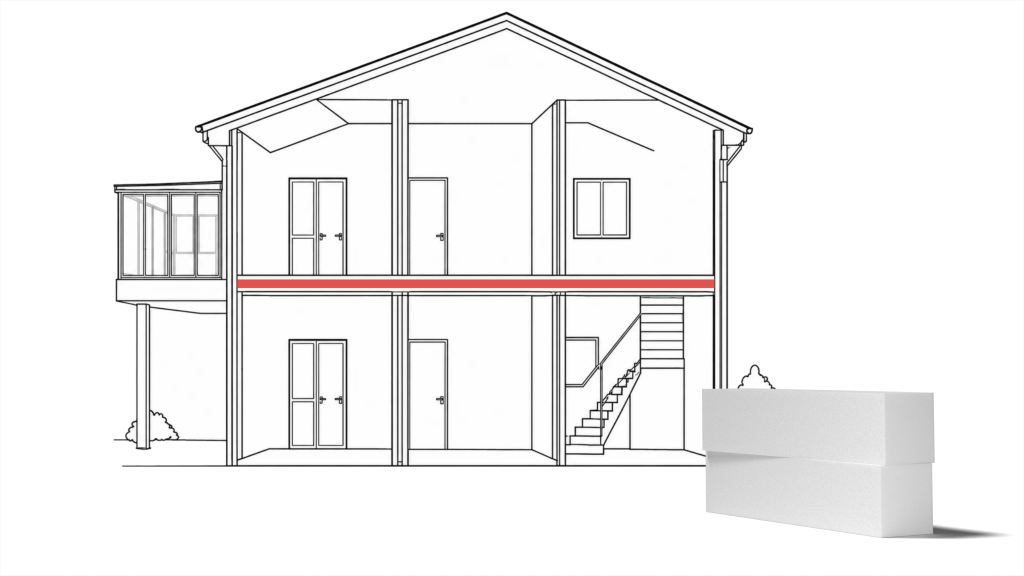
In a ribbed (asmolen) slab, the voids between the joists are filled with lightweight blocks. The EPS asmolen block provides this infill and also forms a thermal insulation layer at the ceiling. According to Mega’s product page, the blocks are produced at 4000 x 1000 x 1000 mm and cut to the required thickness.
Floors with underfloor heating
In wet underfloor heating systems, the EPS underfloor heating board holds the PEX pipes evenly in place under the screed or parquet and supports thermal insulation. We explain the layer sequence and material choice in our guide on underfloor heating insulation.
Road and ground fill
Megafoam is a lightweight EPS fill block used for ground improvement in road, soft ground and airfield fills, bridge beam formwork and landscaping. According to Mega’s technical data sheets, the block size is 50 x 60 x 100 cm. Megafoam is not a facade product; such civil engineering applications also fall outside the scope of EN 13163, which covers thermal insulation products for buildings.
What are the technical properties of EPS?
The main values that define an EPS board are thermal conductivity (λD), compressive strength class CS(10), size and thickness, reaction-to-fire class and service temperature. The technical data sheet values for Mega’s white and grey EPS boards are given below.
| Property | Mega EPS board (EPSW / EPSG) |
|---|---|
| Product standard | TS EN 13163 |
| Board size | 500 x 1000 mm |
| Thickness | 10–100 mm |
| Thermal conductivity (λD) | EPSW: 0.034–0.042 W/mK; EPSG: 0.031–0.036 W/mK (by type) |
| Compressive strength class CS(10) | EPSW: 30–120 kPa; EPSG: 30–70 kPa (by type) |
| Reaction to fire (TS EN 13501-1) | E |
| Maximum service temperature | -50 / +70 °C |
| Conditioning | Block 7 days, board 21 days |
Source: Mega EPSW and EPSG technical data sheets. Values vary by type; always check the data sheet of the type specified for the project.
On the market, EPS is often described by its density. Mega’s EPS board data sheets, however, do not declare density; the board’s behaviour under load is shown by its CS(10) compressive strength class and its insulation performance by its λD value. The choice is made on these two values and on the thickness calculated in the thermal insulation design.
Class E in the table shows that EPS is a combustible material. Where EPS is to be used on a facade, the material and system are therefore selected at the design stage with the fire regulation in mind.
Application note from MegaUsta: On site, store EPS boards indoors if possible, on level timber battens and without stacking the pallets on top of each other. If they have to wait outdoors, cover them with plastic sheeting or a tarpaulin in a way that does not block air flow or let water pool; protect the boards from sunlight as well as from water.
Does EPS provide sound insulation?
Standard EPS board is not a material to choose for sound insulation in walls; its contribution to reducing airborne sound such as speech, music or television is limited. The main job of EPS is thermal insulation.
The EN 13163 standard notes that the EPS products it covers are also used for sound insulation. Mega’s white and grey EPS product pages describe this use as impact sound insulation in floating floors; the technical data sheets, however, declare no sound insulation value.
For airborne sound, the mass of the wall and the correct build-up of its layers are decisive. Where sound insulation is the priority, stone wool based products are the better choice: tests on Mega’s DesiWool panel (W15) at an accredited laboratory measured R’w 29 dB for one-sided application and 42 dB for two-sided application. We cover the options for party walls in our article on wall sound insulation.
Frequently Asked Questions
Are EPS and “strafor” the same thing?
Yes, in everyday Turkish they refer to the same material. “Strafor” is the colloquial Turkish name for expanded polystyrene foam; the Turkish Language Association dictionary defines the word as a spongy material used mainly in building facade cladding and to protect goods from damage in transport. Standards, technical data sheets and product names use the abbreviation EPS. When choosing an insulation board, look at the EPS type and the values in its data sheet, not at the colloquial name.
Why are EPS boards conditioned before use?
To give them dimensional stability. After expansion, EPS blocks and boards keep changing size for a while, so they are stored indoors before use. According to Mega’s EPS technical data sheets, blocks are conditioned for 7 days and boards for 21 days. If a board is bonded to the wall before it has rested long enough and then changes size, gaps can open at the board joints and the render can crack.
What is the reaction-to-fire class of EPS?
The reaction-to-fire class of EPS is E: Mega’s EPS technical data sheets declare class E according to TS EN 13501-1, and EPS is a combustible material. The Turkish Regulation on the Fire Protection of Buildings places class E materials in the “normally flammable” group. Which class a facade requires depends on the building height and on the system as a whole; we have collected the rules in our article on the fire class of insulation materials.
What is an EPS asmolen block used for?
An EPS asmolen block is a lightweight element that fills the voids between the joists of a ribbed (asmolen) slab. It reduces the weight of the slab and adds a thermal insulation layer at the ceiling. According to its technical data sheet, Mega’s EPS asmolen block has compressive strength class CS(10)30 and reaction-to-fire class E. We explain how the slab system is built and which asmolen types exist in our article What Is Asmolen?
Sources
- BSI: BS EN 13163:2012+A2:2016, Thermal insulation products for buildings. Factory made expanded polystyrene (EPS) products. Specification
- Turkish Regulation on the Fire Protection of Buildings (Official Gazette 19.12.2007, No. 26735), Annex 2/A and Annex 2/Ç
- Turkish Language Association, Current Turkish Dictionary: entry “strafor”
- EPS Industry Alliance (North American EPS trade association)
- Mega Insulation Documents: EPS technical data sheets and certificates
- Mega EPS Asmolen Block technical data sheet (PDF)
- Mega Foam technical data sheet (PDF)
To choose the right EPS type for your project, review the technical data sheets on the EPS products page, and for application or product questions, contact the Mega Insulation technical team.